22: Continue creation of basic maps of towns/villages
As I've progressed throughout this series, I've given only quick examples of details in my world, while leaving the major items to your imagination. This article take a very brief look at Coppis, a city with a waterfall running through the middle of it.
I envisioned a city that had layers of rock facades, jutting out from the around the falls, and baskets of some such that would be used to transport supplies to the bottom and continue their journey towards Yggsburgh.
In this case, a party arriving by land from the upstream side of the falls could wind their way down through the city, and come out below, where they would pass through a short tunnel and into Garroting Deep.
Thus, a finished view of the bottom side of The Falls at Coppice:
Saturday, May 28, 2011
Friday, April 15, 2011
Non-Traditional Sandbox Design 10
21: Create basic map of towns/villages
Next I create a basic layout of the towns that I've created in previous steps.
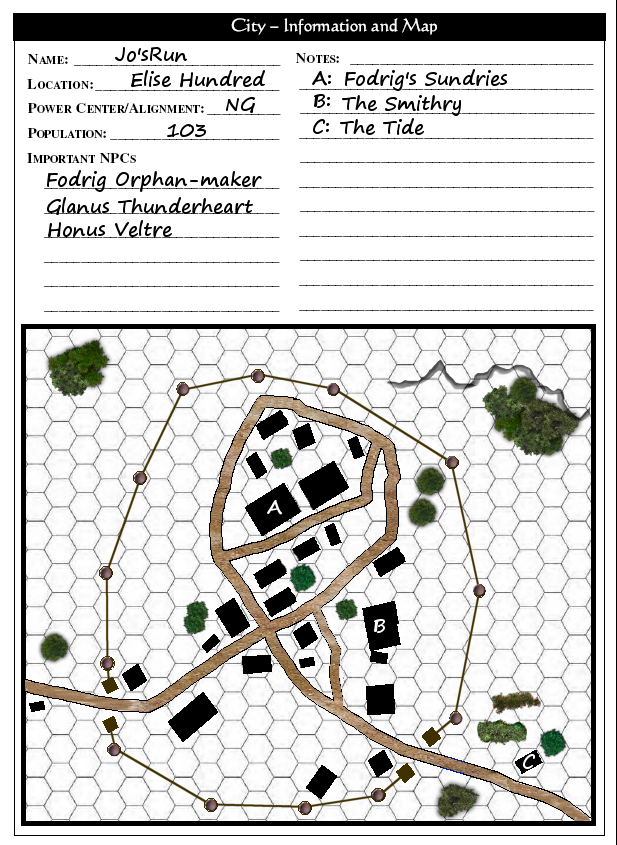
For Jo'sRun, I needed a simple frontier town (population of 109) that had a simplistic walled fortification. This could be used as either a base camp, or jump off location to other areas in the region. For this layout, I used RPG CityMap Generator and after adjusting all the settings, it produced a solid layout I envisioned on the 2nd try. I dropped in the 3 main shops in town, and called it complete.
Herein is the finished city sheet:

22: Devise basic monster backgrounds for regions
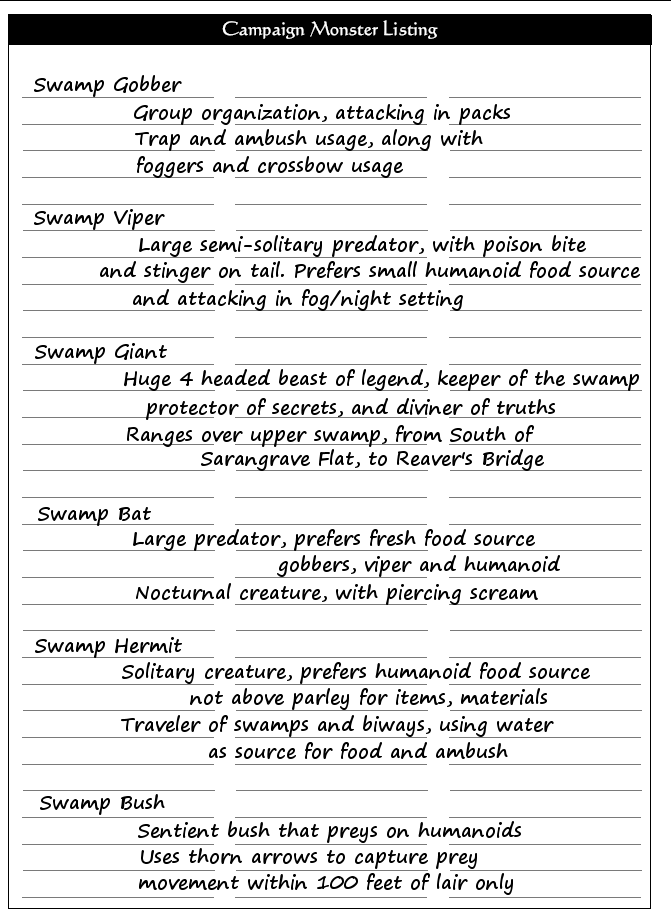
Next I developed a group of monsters for each region of the original map. Some have just a very basic framework, while others have complete stats and background.
For the Corvis Swamp region, I created the following information:

Tuesday, April 12, 2011
Non-Traditional Sandbox Design 9
20: Finish Monthly Calendar (if applicable)
The Monthly Calendar is next on our list. First I decide on the amount of days per month, the length of special seasonal events, if a leap year would be used, and how many moons there are. If moons exist, I set their rotational period.
I lean towards a traditional 30 day calendar for ease of use, but then thought this would be an opportunity to use 28 days and extend each of the 4 major seasonal events to a 6 day period. As an additional bonus, I went with a Leap year, once every 4 years that would be added onto the Summer Solstice.
I employ WeatherMaster, and create a custom world, with all of my info, including the two moons of Isolde; Bast and Nephthys, and their rotational cycles of 29.5 and 20.5 days respectively. By offsetting these cycles, I come up with some very interesting phenomena. A couple are noted here:
On Savor 28 there is a double full moon, known as "The Eyes of Osiris".
On Nuzyael 15 there is a double dark of the moon, known as "Set's Reprieve".
NOTE:
Prior to a session, I'll generate 1 or 2 months worth of weather, moon phases, and any other data I may need.
Herein is the finished Isolde Calendar - Top:
Herein is the finished Isolde Calendar - Bottom:
Non-Traditional Sandbox Design 8
18: Create Guilds and Organizations in the Campaign
At this point its time to create the guilds and organizations that will be central in your campaign. The guilds are really just a way to present new ideas/concepts to your world, and by creating them as a guild, if they prove to be unbalanced during play, its easy enough to explain their change and/or disappearance due to other Guild's reactions to their inner workings.
The Organizations on the other hand may have minor, or major impact on the extended play in your world, so careful thought is needed not to overpower the proceedings early on. Within these organizations you may well find a truly nefarious character or organization that becomes the parties nemesis. I will stress at this point, unless you have a nemesis already fully designed, its best to see where the players go, and not "force" them onto a path where they meet this particular NPC - let the PC's lead the way and plan accordingly.
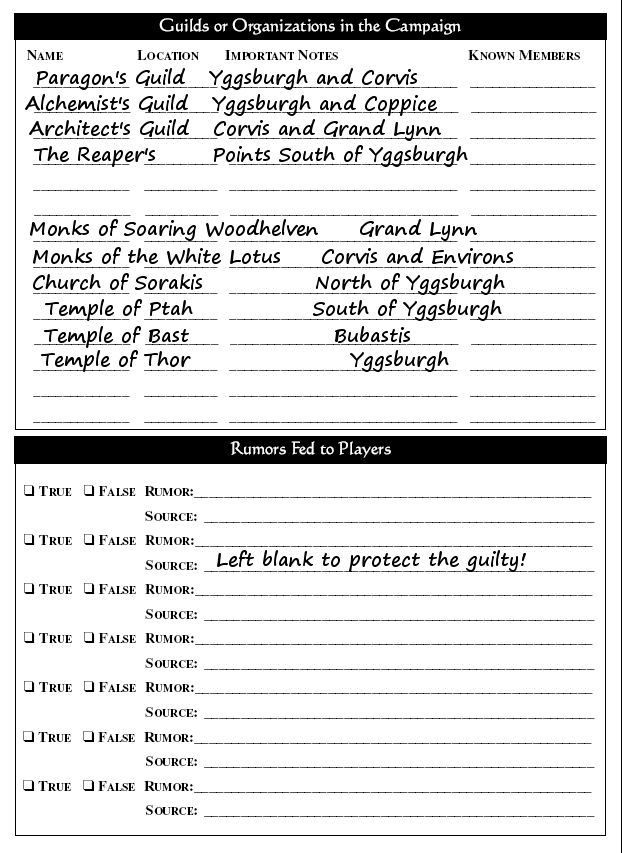
For this step, I created 4 guilds (in addition to existing ones) that might prove to be of aid to the party. Since my campaign uses gem stones in a more magical sense, introducing the Paragon Guild into the campaign was a consideration I leaned towards early on.
I initially created 6 organizations, of which most have some religious tie. Others are much more benign in their design at the onset, and may be developed further down the road.
Herein is the finished Guild/Organization sheet:

19: Lay out detailed notes for special events (if applicable)
This section is for some detailed notes on special events, tournaments or places the PC's may encounter/travel to.
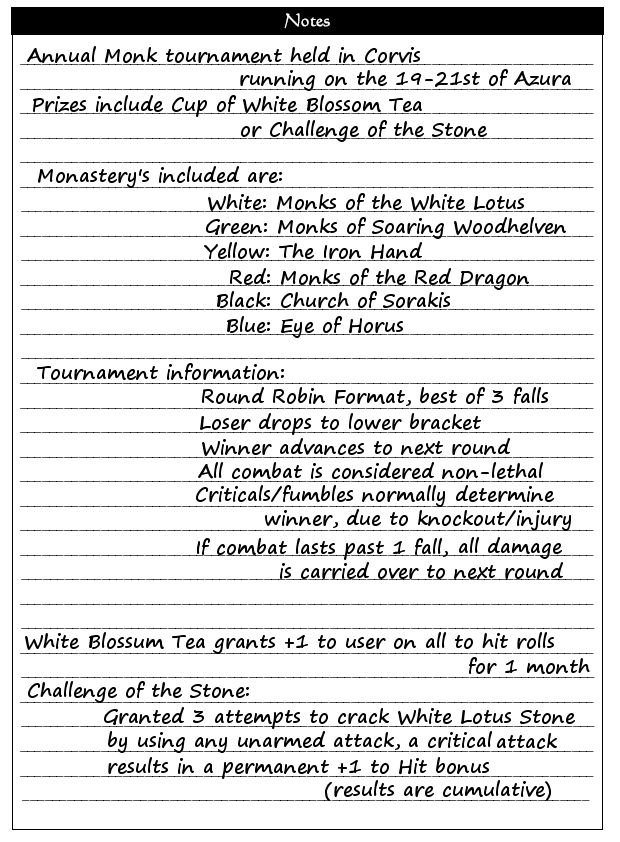
In my case, 3 of the players wanted to create 1st level Monks, yet all three were not sure how long they would survive in the new campaign. Once they were on their way, one idea I had was to create a tournament to entertain and give them a chance to do battle in non-lethal combat while presenting them with a chance to role-play specific attacks. So on the fly I designed a round robin style tournament, and created a quick and dirty combat system. When they arrived at Corvis and spent the night, the next morn they awoke to flyers all around town that spoke of this tournamnet.
1 of the players named each of his attacks, so before the die was rolled for initiative, he would scream out "Flying Tiger Claw" then we'd roll for the advantage. The other 2 quickly picked up on this and hammed it up, coming up with phrases suited to their players style.
I created a 16 monk bracket, and rolled for the NPC matchups. All in all, the final pitted 2 of the players against each other, and everyone had a grand time. The 4th player at the table was so enamored with the fighting styles, he created a monk during the session, and got him in on the action.
This is but one example of a detailed notes section, so herein is the finished sheet:

Non-Traditional Sandbox Design 7
16: Fill out Campaign Events, Holidays, and Specifics for Banking (if applicable)
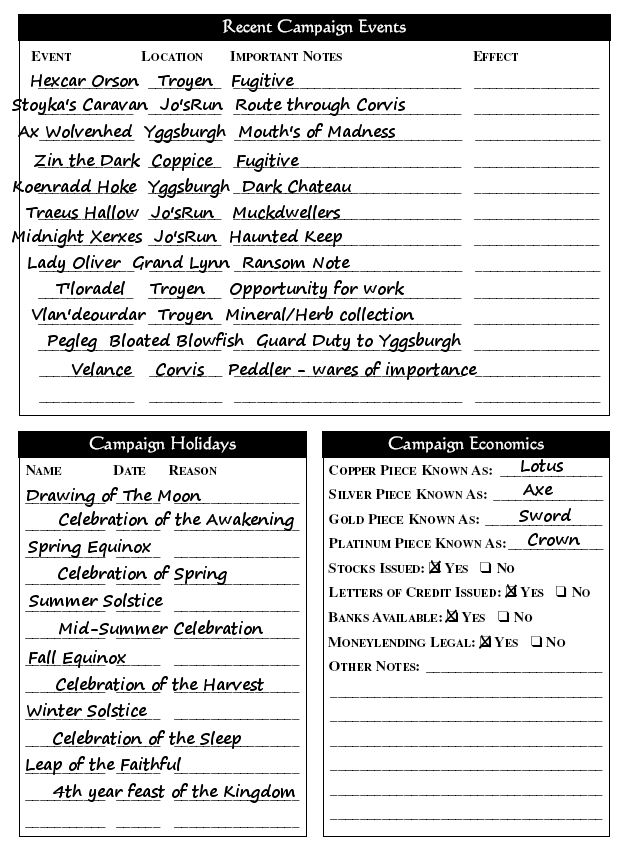
Next was to pull many of the pieces together from previous steps. Plot points that were originally designed to aid the players were added to the Campaign Events, along with notes where needed. The major Holidays were added including notes for clarity, and the coin names were dropped in, while I finished out the banking section.
Herein is the finished Campaign Events sheet:

17: Create Taverns and Shops of interest, to drive Plot Points
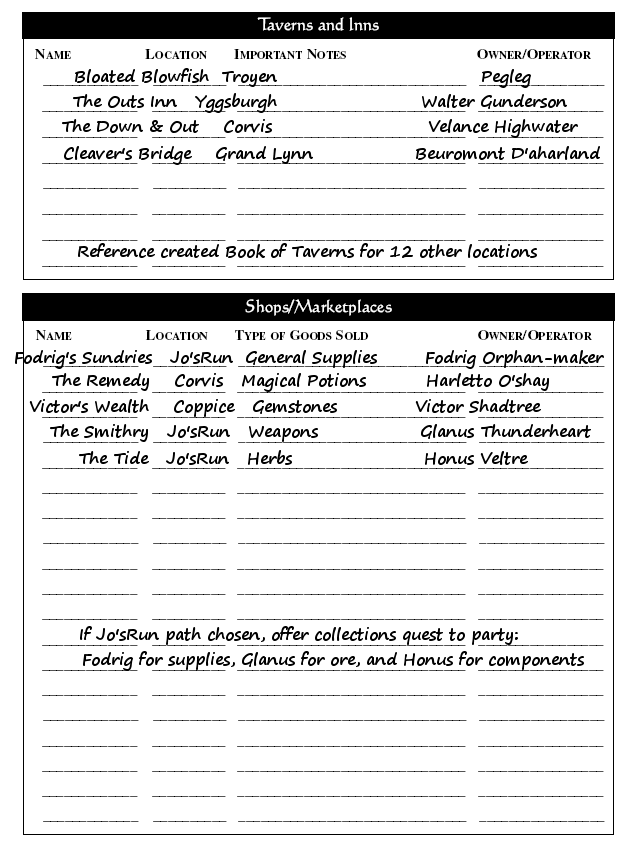
One of my favorite steps is laying out the general details of each Tavern/Inn - i.e., it's name, location, and owner. Along with this I created a few noteworthy general shops that would also fuel the central plots I had created in previous steps.
NOTE:
I would like to stress this point here. The reason for NOT doing all this work is so you aren't bogged down by the idea of the size of the world on the front end. Again, we're not dealing with massive detail here, just a basic outline to focus our gaming session. Details, along with maps, layouts of each building can be created once the player's lean towards that plot point. IF they don't follow a particular path, then there is no reason to give yourself extra work, unless your really in love with a specific place/setting etc.
Herein is the finished Campaign Taverns/Shops sheet:

Non-Traditional Sandbox Design 6
14: Fill out the Campaign Time line, including days/months of the year.
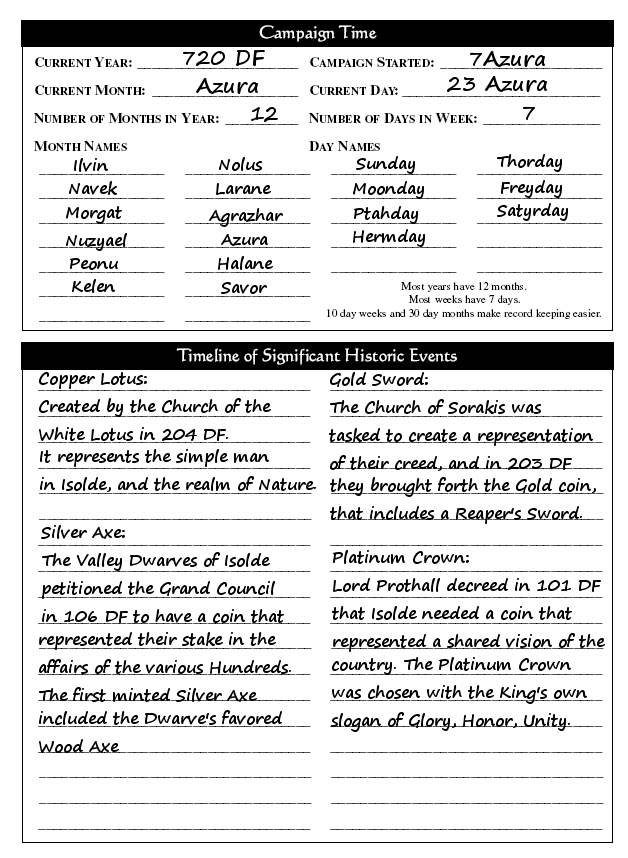
Here I fill out the base time line sheet, starting day, and writing down the months of the year and days of the week taken from step 13. The bottom section of this sheet I used to give origin dates for the coins of the realms, and their creators with a bit of info.
NOTE:
At this point I'm not worried about massive amounts of details, just trying to cover all my essential bases so that the world has a solid foundation. Later on I can go back and add in more details for various events during the gaming session.
Herein is the Campaign Time sheet:

15: Create Coins for the Realms, based on input from previous steps
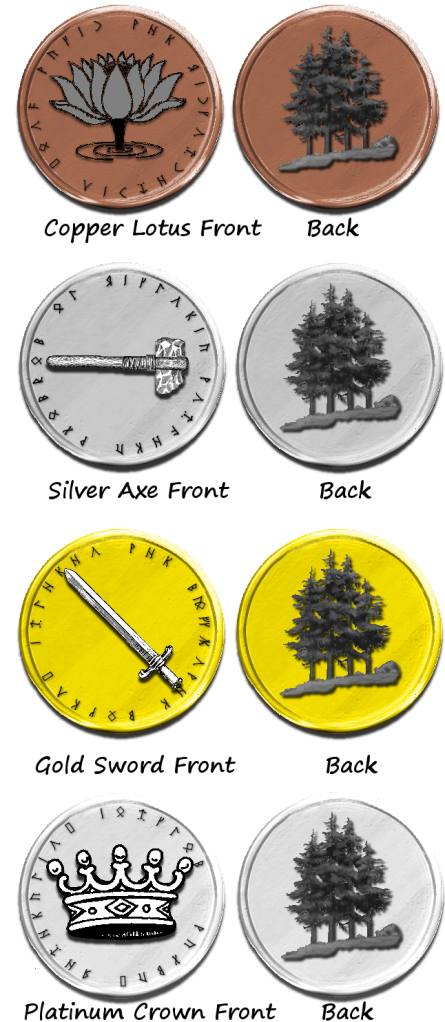
I wanted ease of use over some detailed design, something that the players "could" use if they wished, and decided that 4 large points of interest in the map design process would fuel each coin's history. Hence, the Church of Sorakis claimed the Gold Sword, the Valley Dwarves the Silver Axe, the Monastery the Copper Lotus, and the Royal Family the Platinum Crown.
Once I decided on a design for each "head", I wanted Latin to be central on the coins, yet hidden under the guise of a Harnic Rune. Lastly I pondered what to use on the "tail" or reverse side of each coin. I could have 4 individual designs, front and back, but once I took another look at the Giant Trees at Grand Lynn, it was an easy choice to include a simple Grove of Trees as a single point of continuity for all the coins.
Herein are the finished coins of the realms:

Non-Traditional Sandbox Design 5
13: Create Calendar, and holiday/events of note.
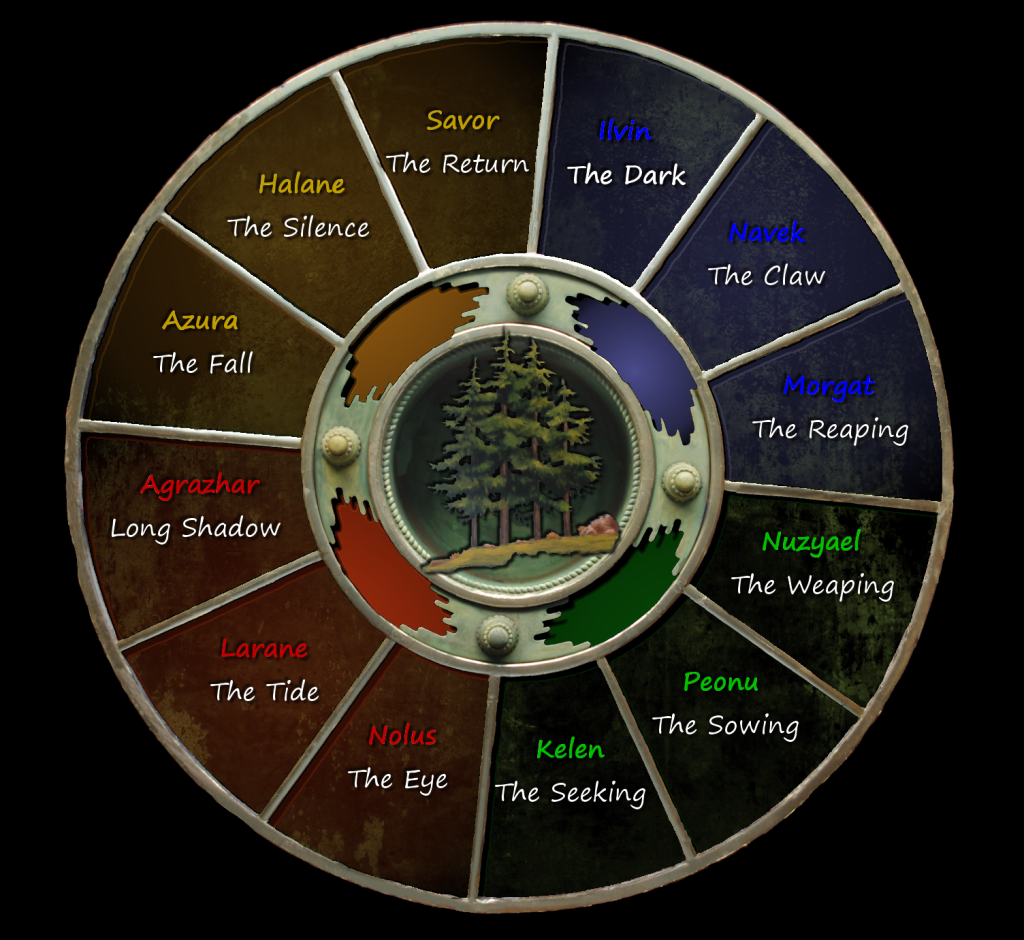
Each month has 30 days, with 5 special events throughout the year. Equinox, Solstice and Drawing are major days that the people look forward to throughout the year, and are known as markers for fairs, tournaments and feasts. Leap of the Faithful happens but once every 4 years, and is a day that the commoners may speak openly with their leaders/kings, and major tournaments are held on this day.
As for names of each month, I wanted to pay tribute to Harn by using their Month names, and adding in my own common names that the people of Isolde would use. The Gregorian references are only included here for clarity.
Drawing of The Moon
Janus: Ilvin: The Dark
Februs: Navek: The Claw
March: Morgat: The Reaping
Spring Equinox
Aprus: Nuzyael: The Weaping
May: Peonu: The Sowing
Junus: Kelen: The Seeking
Summer Solstice
Julus: Nolus: The Eye
Augus: Larane: The Tide
Septem: Agrazhar: Long Shadow
Fall Equinox
Octob: Azura: The Fall
Novem: Halane: The Silence
Decem: Savor: The Return
Winter Solstice
Leap of the Faithful (Once every 4 years)
I wanted to create a circular calendar, that would quickly associate each 3 month section with a color reminiscent of that season. Included herein is the finished Isolde Calendar:

I wanted to create a circular calendar, that would quickly associate each 3 month section with a color reminiscent of that season. Included herein is the finished Isolde Calendar:

Subscribe to:
Posts (Atom)