Friday, September 21, 2012

Dungeonographer Quick-Review

For some time, I've been hailing the virtues of Fractal Mapper 8 http://www.nbos.com/products/mapper/mapper.htm to create solid fantasy worlds and dungeons. Few products on the market can match it for price and flexibility, and I've done plenty of work with it on this very blog.

From Overland maps:
Case Study Archipelago
Gone Fishing Module

to a 3 level Dungeon :
Well of Lost Souls, Level 1
Well of Lost Souls, Level 2
Well of Lost Souls, Level 3

*****
Now from Inkwell Ideas, the makers of Hexographer, comes Dungeonographer.

It's built to run via Java, and I've tried out the free version to test its capabilities on my Windows 7 laptop prior to investing in the full "Pro" version. Overall, there is a ton to like with the layout, from choosing the size of the base map to placing items and building your own dungeon.

A Random Dungeon Generator is included, and as you'll see in the screenshots, it has a solid design


After clicking Generate Map, the Random Map is displayed. I love that this can be used to inspire/give ideas, and you can fully edit the Generated map within the tools. Below is a map created using the default settings (as seen above).


Tabs run along the top of the main window. Here you can switch to each and custom set the look of colors for your specific needs. Remember to click APPLY when finished otherwise the settings will not be applied to your current design.


Choose a floor tile, left click on it to highlight it and then simply click in the main window, or left drag to fill a larger area. I would like to see the ability to flood fill a chosen section, for larger maps, but this is quick and very easy to use.


The right side of Dungeonographers main window is dedicated to buttons that provide you access to the various tools you'll need. Below I'm showing each with some highlights.


The Map Items tab gives you access to a wide range of items, all broken down by a Filter. Need doors, choose doors from the drop down filter and your set. I would like to see a separate category or folder structure to help me isolate just Medieval/Fantasy style items, but this shortcoming is minimal compared to the ability to import your own custom items.


You can draw freehand (Erol Otus style), or use the Snap-to-Vertex mode. To delete a line, choose the Select Line and choose it then hit delete. I would like to see the ability to move an entire line, or even a single vertex point., but very versatile tools are included here


Being able to combine smooth walls and caverns together is a breeze within Dungeonographer., as shown below.


Some odds and ends here, highlights include being able to save as png and also choose the exact scale I need. Boom, winner, winner, Beholder dinner!. This is far and away a feature that every tool should have, and this one pushes Dungeonographer way up the scale of goodness.


The two previous posts on this blog, "Old Reaver's Tomb" and "Cult of the Owlbear" feature maps that were created in 15 minutes with Dungeonographer. What I find to be the best reason to upgrade to the full "pro" version is the amount of time you'll save in creating a dungeon complex.

Joe has done a brilliant job in the design of Dungeonographer, and it is indeed a very versatile product. The full Pro version is $25.99, and should be, in this persons opinion, the defacto search when you type Dungeon Designer in Google. It's that good!

Cheers,

Cult of the Owlbear

August 9th, 1977 Original Concept

The upper level of Old Reaver's Tomb came about due to my grandmother's love for owls and my fascination with a creature from D&D that never seems to get much love, the Owlbear.

*****
 The central stairs lead upward to the level proper, where cultists live and "play" as it were. Two separate exits lead to the surface, both of which share buildings in the small village of Reaver's Bridge. This gives the cultists prime access to the River, Salt Route and Forest for victims and escape into the night.

The main cavern has a triple set of statues; two smaller at the base of the natural steps (on either side of the lava pool) and a large central statue to Osh'gystue, God of the Owlbears. 

Old Reaver's Tomb


August 9th, 1977 Original Concept

This long forgotten tomb was originally conceived after a neighborhood friend and I spent the day underneath the bridge at my grandfather's house. We built up some boards in the creek, and as the water slowly built up, it became our own little wading pond - with enough depth to sit on the shelf under the bridge proper. I had some hex paper in my drawing kit and as part of the original design of Isolde Delta, I felt that placing tombs/barrows/stone circles would be an integral part of the layout, and also gave the world more depth.

*****
The Brown River begins in the Crestfallen Mountains, and has a gentle journey before falling downward 4800 feet to an upper plateau near a precipice. From there the river runs to the Southeast and plummets at Landsdrop, forming the sister rivers; Plume and Soulease.

Here, the sisters split, the Soulease runs westward around the basin of Landsdrop, while the Plume drops into the Vale of Shadows. The rapids in this region plunge downward to the East, bringing up deep ore deposits as it rips through the hardened upper regions, and finally calms as the Plume joins with Reaver's Gorge at Corvis. 

Reaver's Gorge meanders to the Southwest dropping some 200 feet over the course of the 20 mile journey to Reaver's Bridge. The river then flows into Andelain and splits again, part of it dropping ever South, while a slower vein travels Westward before joining with it's sister, the Soulease South of Coppice.

*****
Most of the shoreline near Reaver's Bridge is manageable only in the Fall and dead of Winter, in part due to the height of the river during the rest of the year. Some of the locals fish these regions, and tales speak of caves that contain more than the dead carcass of unfortunate animals looking for a warm place to sleep.


Thursday, August 23, 2012

Combined World Map

As part of an ongoing Campaign Design/History I've been assembling, our group - the Foaming Flagons decided to create a single world map that we will adventure in. John was kind enough to assemble the main layout, with the only pieces missing being Harn and The Land. I added those in, and currently:

John has his 0E campaign in the Wilderlands
Brett has his 2E campaign in Faerun
I have my 1E campaign in The Land/Harn


The benefit of such a world is that there is the very real possibility that the players from different campaigns may well meet each other/adventure together. But more-so was the concept that we all agreed upon of a "Living City within a Dungeon" complex.

The group in my campaign is at a point that they might well descend into one of these Living City levels within Castle Zagyg (depending on which of the 3 sets of stairs they choose).

Lastly, in the very near future, I'm gearing up to run a Middle Earth campaign set during the 2nd Age - just forget any reference to the ring and you've got the correct mindset.

Cheers,

Tuesday, June 26, 2012

1E Wilderness Encounters with Random Terrain Features

Greetings,

For some time I've been trying to create a set of Wilderness Encounter Tables that were broken down by the various Terrain Types that are found in my world. But I wasn't satisfied with just monsters because my campaign has been designed using an early 1977 Micro-Sandbox Concept i.e., building outward from a single starting point of interest - in this case the Bloated Blowfish Tavern. Because of that I wanted tables that would be dual purpose, namely:

A) Used to help fill out the world as the players adventured using both Monster and Random Terrain features.

B) Used to inspire me to create points of interest as I expand the world, because lets face it, any DM who creates a world wants to enjoy the journey as much as his players - or, in my case, even more.

They don't have every single possible Terrain feature, but serve as a basis to help.

Sadly though, I struggled for some time to quantify features the tables might refer to like Ruin, Giant Tree, Coral Reef, Swamp Lights etc., and more importantly how best to reference sub-tables properly. Then while browsing the 3W, I stumbled across this post over at Enworld:

http://www.enworld.org/forum/d-d-4th-edition-discussion/271564-random-terrain-features-natural-world.html

So I grabbed the content and edited the information to fit my 1E game, and finished by adding in a few new tables/items that fit my campaign and called it done. Included below is a bit of information with screenshots of the finished [1E] Wilderness Pdf:

Page 1 includes a Frequency and Encounter table broken down by 1D8+1D12 and D100. I included this for my own reference, but also in case a fellow DM needed a handy reference for their own table design.

The bottom of Page 1 includes a chart with the 12 Wilderness Encounter tables. This also includes information on what each table includes:

The next 4 pages are the charts themselves, herein are tables 9 through 12:

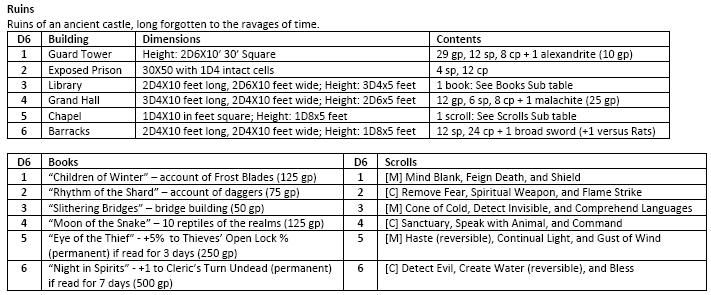
The last 5 pages include all the sub-tables (where applicable), that detail the "special" types of terrain features. Included herein is the Ruins section:


Lastly, I've uploaded the pdf to my Dropbox account for your use.

1E Random Wilderness Encounters

Cheers,

Saturday, June 9, 2012

1E Advanced Herbs Guide

June 9, 1977 Original Concept

Good lord, 35 years ago to the day I started an Herb Document, complete with tables and the like and somewhere along the line I never finished it. Amazing what happens when you have a bit of time, so all these years later here it is:

INTRODUCTION
The party had made it out of the woods after a long sojourn into the Evermyst Forest, breaking through the heavy underbrush they found themselves on the outskirts of small Thorpe. A farmer noted their passing as they carried two gurneys with their wounded, but when they asked for directions the reply was disheartening.

“Aye, tis sad ta hear, but da closest aid is twenty leagues away in Coppice.” The farmer offered them fresh water from his well, then continued “You might wan’na try old Charlet up the road a spell. She’s odd that one, but people say she’s got da touch”. He glanced at one of the men lying on a stretcher and his stomach blanched, for deep wounds crossed his left shoulder and the man’s skin was a bluish-black in color. He quickly pointed them up the road, and backed away. With a word of thanks the party quickly moved on, the farmer watching as they passed out of sight. As they did he bowed his head, said a quick prayer, then set to plowing his field with the twin oxen.

They made it to the dilapidated hut just before nightfall, and though they were want to walk into another situation the condition of their comrades demanded speed. Light flickered from the cracks in the door, so the fighter pulled sword and hit the butt on the wood. A voice garbled but clear replied “Ya won’t find anything but trouble here, so be gone!”

“Sorry to bother you ma’am, but we heard you might be able to help our friends”. “Bother” was the reply from within. The Ranger ever tactful said “We were sent by the farmer up the road, he said you had healing...” The door wrenched open and a craggily bent woman appeared. She shuffled by the fighter carrying a torch and bent near the first gurney. “How long?” she asked.

“Well we’ve been in the woods these last…” She spun on her heals quickly and came to face the startled thief “When I ask ye how long, I mean simply how long ago was he clawed”. The mage said simply “a day”. She snorted “More like two and we need speed if we’re to save ‘em. You…” she pointed to the thief,”… up the hollow is a triple set of oaks, near their base is a Sassafras bush, I need four twigs, thicker than they are long, peeled but bark saved”.

She turned to the fighter, “I need ya to journey to Crag’s Peak, but twice a Storm Giant’s throw from here to the East. There ya will find a dense growth of Conberry – ya can’t miss ‘em for their perty orange color in torch light, bring me back…”she grabbed the man’s hands and studied them for a moment then continued “three hands full”.

“Off with the both of you and hurry!” Both men stared at her for a moment before leaving, as she turned to eye the mage and ranger. The spellcaster stood to the side reading from his traveling spell book in the torchlight while the ranger knelt near one of the gurneys. The mage never glanced up, but gently closed the book and replied “...and what dear lady shall you want from me?”

She cackled, then glared at him, “Mage, you and the Ranger ‘ill help me create a Decoction by giving me some of your blood”. The look on the ranger’s face made her cackle again.


BACKGROUND:
Herbs are rarely used in game, albeit there are occasions where you may find them referenced in quests and tables of rumors. Oddly this is one of those areas where a 1E game can benefit from their inclusion, at least in this DM’s mind. For years I’ve promoted the use of Gems in gaming sessions, having enough background material handy in case a player wanted to have more detail on that special gem they just discovered in the dead Orc’s glove.

But let’s face it, rarely does a player want to do plant research, nor do they wish to fumble around studying some herb only to discover its best suited for the occasional bout of morning sickness. Yet, if they discover that a plant is poisonous or can be used to heal wounds, well that’s a different story altogether.

So this guide was created to help those DM’s whom want or need to have a bit more detail at their fingertips for campaign design – or even for that one off that needs a bit more flavor. Most DM’s won’t want or need this amount of detail, so this is certainly a niche design, with little value.

Having said that, the following pages will give background information and detail herbs as found in my Isolde-Delta Campaign. As well, I’m including a basic listing of those herbs found in the Dungeon Master’s Guide within this document for two reasons. The first is so you can see that they can be used in any campaign, and secondly because I feel showing you how I’ve designed the tables to include them might aid you to create your own set for your world. But I also set out to make these tables as user-friendly as possible for the DM so you can do a wider variety of things.

1) If your party is in a certain area, say a mixed forest and want to know what type of plant life grows there, you can reference these tables broken down by rarity of region.

2) If you’re designing a custom plant for your campaign, and are unsure about how to go about the process, I detail a fairly straight forward method that should aid you in filling in all the blanks. Included are blank templates and charts to assist you with this task.

3) If you need to add some *ahem* spice to flesh out a campaign or module, you can simply cross-index the appropriate region and find what might live there.

Understand that the material presented within is only meant as a guideline, and you’re free to use it as is, alter it to fit your own desires, or not at your own fancy. Caveat Emptor or “Let the DM beware!”

*****

HERBS BY HABITAT
The following tables, broken down by habitat, pull all the herbs from the Master List found on the previous pages. These tables were created specifically for the Isolde-Delta Campaign, but are included herein to aid in showing how such a table can be created, and in a pinch used to generate randomly found herbs in any campaign.

Usage: 2 Options exist:
1) In Black: Decide habitat and rarity, and then roll percentile dice to find the proper herb.
2) In Red: Decide habitat, then roll percentile dice to find the proper herb

Example 1: The party is traveling through a Conifer Forest and they happen upon a Glen which is home to a witch doctor. The Dm rolls % dice (twice) – consulting the BLACK Numbers on the Conifer/Uncommon Chart and comes up with 65 and 16, respectively. Thus, the NPC has Anserke and Ukur amongst his wares. 

Example 2: The party is traveling through a Mixed Forest, and one of the players is noting what herbs he finds near a set of Ancient Ruins – as part of a research quest for a local village. The DM decides that 4 such herbs will be found and then rolls % dice – consulting the RED Numbers on the Mixed Forest Chart and comes up with 19, 84, 36, and 58. Thus, the PCS find Thurl (VC), Mandrake (VR), Elendial’s Basket (C) and Slagen (C).

I'm including a snippet of the Alpine/Mountain, Coastal and Conifer charts below so you can see a sample of how they work:


Below, and in the archive section you can find the link to the pdf file:

1E Advanced Herbs Guide

Monday, April 23, 2012

1E Geomancer Class

Geomancer Character

May 5, 1977 Original Design

Today was a red-letter day. The first successful testing of the gem class with six players and two NPC's. During the play-test, questions arose after two of the three gem class users hailed from a very rural community and another from a large city - which had mining as one of it's chief resources. The question was how would you modify the class to give a slight advantage to different backgrounds they were raised in. After an hour of brainstorming, I offered a "where trained" modifier to be added to the players combined Wisdom and Constitution, with the resulting total falling into a specific range that would help to decide starting stones available.

One player noted he was hoping to see more lower level spells that had some alternate abilities. This original question came long before Unearthed Arcana arrived on the scene and while 12 spells originally were developed for this class, part of the fun was coming up with mundane uses for the stones. During a visit to an out of the way Inn, one player scribbled a note and asked "any way I can use a stone to spoil the food"?

I thought for a couple seconds before writing back: "sure - what about a bloodstone - you got one of those." He improvised, and a few minutes later when the barkeep was informed the food had gone bad, the entire party got free fresh food and board for the night. "Taint Food" was born.

Spells like Thunderclap were developed on a tremendous night of summer storms in 82, and Tsunami followed in 88 after I almost drowned in a pool when a man 5 times my size did the biggest cannonball I'd ever seen/felt. 

*****
So now 35 years later, the class is near completion and I present the introduction from the PDF:

Geomancers are an earth–based class, neither Mage nor Cleric, yet a combination of both. They have an innate ability to cast spells directly from the gems and stones that exist around them and thus through attunement, a Geomancer is capable of gradually deepening his connection to a stone and drawing out the vital energy that the stone possesses. Since the Geomancer is capable of casting spells across the full spectrum, they are able to wear any non-metal armor – although their preference is leather or padded. However, due to limitations they are incapable of using a shield and are somewhat restricted on weapons they may employ in combat.

They can play an important support role for an adventuring party. Because they are capable of Personal, Offensive and Defensive spells, they are capable of doling out significant damage, but they should never be considered as a front line fighter. They rely on the gems and stones they find to power their abilities, and thus do not need to use material spell components, mistletoe or a holy symbol.

Geomancers spend an exorbitant amount of time collecting and studying gems and stones. Many subsidize their stockpiles by working at a Lapidary or Gem shop where they can pick over incoming supplies from adventuring parties, and also study new levels of attunement. A Geomancer, if informed of a rare stone, is likely to drop everything and rush off to obtain such items, often disappearing and not returning for many months… if at all.

Upon reaching 11th level (Diamond Keeper) a Geomancer may decide to settle down and begin spell research full time. Devoting their lives to the attunement and study of mixing stones, most take up roles at large libraries where they have the greatest chance to happen upon records denoting special gem collections. If a collection is known to exist, you can bet a Geomancer has already studied it, or is nearby.  In many cases, they start their own order, and followers and acolytes will flock to the Geomancer’s banner.

*****

Here is the link to the PDF, which you can also find in the Archives section:

Cheers,