Saturday, April 9, 2011

Campaign History: Librams and Tomes

One of the first things I wanted to focus on was the creation of some special books that could aid players if they found them. For each book that has a positive effect on a player's stat, there is indeed a singular volume of each that grants the opposite effect, i.e., a book that is cursed.


Orpusl of the Sword:
Black leather book, with Longsword across cover. 

Corded binding with silver pages.
Weight: 3 lb.

This treatise contains expert advice and instruction in the art of sword and shield. Each page contains detailed accounts of combat techniques and sketches intended to aid the reader. A fighter, paladin or ranger who spends one week studying the manual gains a +1 inherent bonus to Strength and experience points sufficient to place him or her halfway into the next level of experience. Except as indicated above, the writing in a Orpusl of the Sword can’t be distinguished from any other book until perused. Once read, the book vanishes, never to be seen again, nor can the same character ever benefit from reading a similar tome a second time.


Folio of the Hand:
Soft leather book, with White Lotus on cover. 

Corded binding with copper pages.
Weight: 4 lb.

This treatise contains expert advice and instruction in the art of unarmed combat. Each page contains detailed accounts of combat techniques and sketches intended to aid the reader. A monk who spends one week studying the manual gains a +1 inherent bonus to Constitution and experience points sufficient to place him or her halfway into the next level of experience. Except as indicated above, the writing in a Folio of the Hand can’t be distinguished from any other book until perused. Once read, the book vanishes, never to be seen again, nor can the same character ever benefit from reading a similar tome a second time.


Opuscule of the Bow:
Dark leather book, with Arrow on cover. 

Corded binding with bronze pages.
Weight: 4 lb.

This treatise contains expert advice and instruction in the art of bow and arrow. Each page contains detailed accounts of combat techniques and sketches intended to aid the reader. A ranger who spends one week studying the manual gains a +1 inherent bonus to Strength and experience points sufficient to place him or her halfway into the next level of experience. Except as indicated above, the writing in a Opuscule of the Bow can’t be distinguished from any other book until perused. Once read, the book vanishes, never to be seen again, nor can the same character ever benefit from reading a similar tome a second time.


Tome of The Eye:
Scored leather book, with pierced eye on cover. 

Corded binding with stained pages.
Weight: 5 lb.

This mystic book is of great value to illusionist and mages of good alignment (LG, NG, CG). Study of the work requires one week. Upon completion, the caster gains a +1 inherent bonus to their Intelligence and experience points sufficient to place him or her halfway into the next level of experience. Except as indicated above, the writing in the Tome of the Eye can’t be distinguished from any other book until perused. Once read, the book vanishes, never to be seen again, nor can the same character ever benefit from reading a similar tome a second time.


Edifice of The Stars:
White leather book, with falling star on cover. 

Corded binding with faded blue pages.
Weight: 6 lb.

This mystic book is of great value to clerics of good alignment (LG, NG, CG). Study of the work requires one week. Upon completion, the cleric gains a +1 inherent bonus to their Wisdom and experience points sufficient to place him or her halfway into the next level of experience. Except as indicated above, the writing in the Edifice of the Stars can’t be distinguished from any other book until perused. Once read, the book vanishes, never to be seen again, nor can the same character ever benefit from reading a similar tome a second time.


Ordunam of the Tree:
Supple leather book, with forest on cover. 

Corded binding with green pages.
Weight: 7 lb.

This mystic book is of great value to druids. Study of the work requires one week. Upon completion, the druid gains a +1 inherent bonus to their Wisdom and experience points sufficient to place him or her halfway into the next level of experience. Except as indicated above, the writing in the Ordunam of the Tree can’t be distinguished from any other book until perused. Once read, the book vanishes, never to be seen again, nor can the same character ever benefit from reading a similar tome a second time.


Vespers of the Mind:
Solid slate book, barren cover. 

Heavy Corded binding.
Weight: 12 lb.

This heavy book contains instruction on improving memory, logic and lore. Any class may read this tome and by doing so, which takes a total of 48 hours over a minimum of six days, they gain an inherent bonus of from +1 to +4 to their Intelligence score. In addition, the reader will earn an extra 10% experience when attaining a new level. Once read, the book vanishes, never to be seen again, nor can the same character ever benefit from reading a similar tome a second time.


Opus of Grandeur:
Heavy wood, with golden swirls on cover. 
Silk corded binding with white pages.
Weight 10 lb.

This large ponderous book gives a detailed account of the life of Haerium Ost'Versuer a master of suggestion and persuasion. If anyone reads this book, which takes a total of 48 hours over a minimum of six days, they gain an inherent bonus of from +1 to +4 to their Charisma score. Once read, the book vanishes, never to be seen again, nor can the same character ever benefit from reading a similar tome a second time.


Libram of Mentality:
Heavy wood, with silver swirls on cover. 

Satin corded binding with black pages.
Weight 8 lb.

This large ponderous book gives a detailed account of Men-Ptah, a master of instinct and perception. If anyone reads this book, which takes a total of 48 hours over a minimum of six days, they gains an inherent bonus of from +1 to +4 to their Wisdom score. Once read, the book vanishes, never to be seen again, nor can the same character ever benefit from reading a similar tome a second time.

Campaign History: Visions of the MageBone

Archmage Malachai Vision once wrote that: "nothing is more pleasing to my perverse sense of nature than to hide my property in ways that few would ever discover. Part of that ideology comes from the concept of hindering a party that has discovered a ancient tomb. Whilst the players are investigating it, they happen across a room bereft of anything but a couple coins and simply move on, ignoring the skeleton or parts of laying haphazardly around."


"Thus, over time, I developed a complex magic process to effect the bones on a subtle scale, and to allow me to place potions and even scrolls inside it".

"Any bone will do, from the size of a halfling up to even a great wyrm. However the amount of marrow that the bone has will greatly effect the amount of liquid that can be placed inside once the arcane magic has been woven into it. I lean towards human size because; of their immediate access, and they are the most common that are found in crypts/dungeons. However, for the curious, it isn't above my nature to endeavor to collect the bones of dwarves and elves, so that they too can be placed into deep dungeons where they may well have lived".

Normal bone with marrow intact

"The process takes seven days, and the bone must not have been shattered nor broken in half. Once it passes that inspection, the marrow is drawn out by using the spell Marrow Dust. A small canticle of little consequence that when cast changes the marrow to dust, and can be quickly removed. The double benefit of this spell is the bone can be quickly shaken in full light, and if any dust falls off the bone, then a mage will know the bone has a small hole or crack that needs to be filled. The dust is collected and used in step four".

Normal bone with marrow removed


"Once the bone has had the marrow removed, the next step is to prepare the sealing magic. This spell, known as Marrow Weld, will in effect fill any small gaps/cracks or holes found after Marrow Dust has been cast. It creates a small inner liner, thus protecting any liquid or scroll that is placed inside".

Normal bone - with seal in place

"Next, a stopper needs to be created that will not only serve as a seal for the top, but also will allow the bone to pass normal inspection. This uses the spell Marrow Seal to create a small cut around one end of the bone, where the liquid can be added. On the human femur, this area is known as the Head".

"A small rune is then carved onto this cut, and then the bone is placed in direct moonlight for 1 hour, and sprinkled with the marrow dust of the bone to seal the magic in place. After that, the bone may have any liquid other than acid placed in it or even a small scroll. Once satisfied with the new contents, the stopper is replaced and a magical word is spoken. This seals the bone, and completes the process".

MageBone, with Healing Potion


*****
To spot a MageBone, a roll vs. Intelligence at +4 must be made. If a player successfully identifies a MageBone, they'll notice a small rune carved in the bone at one end. By tracing the rune, the endcap shifts ever so slightly and may be removed to reveal the contents within. Failure denotes a simple weathered bone.

Other varieties require a phrase, a spell component, a knock spell and even a drop of blood to open.

1977 December - The Muckdweller

~~Background 1977 - December 27 ~~

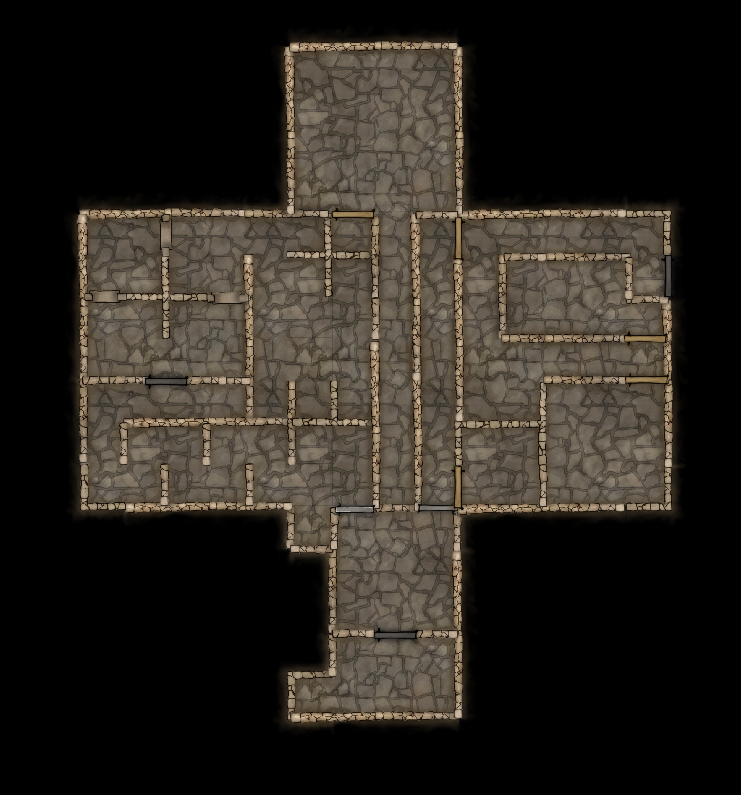
I had this idea for a dark place, filled with a bit of history, and one of my favorite gaming elements - a maze. I had the opportunity to walk a real maze near my Aunt and Uncle's house in Virginia earlier that summer and was blown away by the experience. Thus "The Muckdweller" was born...

This adventure is based on the tragic loss of four children whom disappeared during the midst of a summer festival near Jo'srun. After a few weeks of searching a sense of hopelessness has fallen on the town but a hermit, living in an abandoned complex was suspected of the crime and a few brave locals volunteered to go bring him in for questioning. They were never seen again.

As time passed, and as local legends tend to do, the tale of the Muckdweller grew, and a woeful song whispered on the dark of the moon was born:

"From hill ta hill and vale to vale, no sound replies,
barren and dark deep in the muck, listen to the lies
Four small souls taken away, deep in the night
Lost and not forgotten, hope they yet fight
Old dark hermit deep in the muck, leave us alone
Dark night of grace, filled with woe, how shall we atone"

*****
NOTE:
I'm trying out Maptools (available for free at http://www.rptools.net/) to redraw all of my original maps, and so far am finding it to be a solid tool, especially with the ability to add in my own designed elements. Maptools can be used for virtual tabletop games, but in this case, I 've been searching for a tool that I can quickly recreate interior maps with little fuss. This first map was done in 10 minutes.
*****

1977 December - The Muckdweller : Part 2

~~Background 1977 - December 27 ~~

Once the players started exploring the main section of the dungeon, I quickly discovered that Abe, Seth and Victor were very adept at solving the level. It wasn't meant to be a massive place, but when they decided to rest in the first pool room (after securing both sets of doors on either end of that part of the complex), I decided an expansion was needed. Thus "The Muckdweller: Level 2" was born...


1977 December - The Muckdweller : Notes

~~Background 1977 - December 28 ~~

I sat down to fill out the back story of The Muckdweller and quickly realized most of the work was already done - except for two small areas near the main entrance.

I wanted the adventure to include a large set of possible hooks, and hopefully expand outward into a full blown campaign that the players would want to live in and explore. Little did I know how this one small dungeon would lead to 27 years of adventuring in Isolde-Delta, and along the way I'd discover a hobby that would last me a lifetime.

Included below is a snippet of information from the longest active player, Robert:

"Where to start? Isolde-Delta was a place that we spent so much time in, it became a second home. 

One of my characters, a fighter by the name of Haran, went from a lowly first level to a full blown castle owner in five years and later became a Lord of Light. My favorite adventure entailed our busting into a Manor that had fallen into the hands of the Church of Sorakis during one of their "services" and rescuing two small children and a grown man. Turned out the priest's enslaved the unfortunate, selling the strong in the Swamps of Mear to the highest bidder and sacrificing the unwilling-to serve females to Sorakis". 

*****
Thus, here ends the backstory of The Muckweller ... for a bit.

1977 December - The Muckdweller : Part 3

~~Background 1977 - December 28 ~~

This area was originally designed after watching a small torrent of rain in the woods behind my Grandparent's house. The central theme was intended to give players a wide range of activities to accomplish, or be a quick and dirty muckup. It progressed quickly to a full fledged 3rd level.

Friday, April 1, 2011

Project X: Part 13

*****
Familiar
Version 1.2D (Shareware)
Red When Excited
Status: Inactive **
There have been 3 software programs developed for 1E through 4E on the market named Familiar. This is the earliest version, and is one of the most complete packages for character design I've had the pleasure to use. It is based on 2E, but with small changes it fits the 1E game very well. The key words here are flexibility, ease of use, and solid design. One of the high points is the way in which you interact with the various items/weapons etc. throughout the creation process. When its time to outfit a character, you first select the + sign on the weapons tab, which opens a context folder that has all the weapon types listed. then simply choose the folder that applies to your choice, and then click the "hand" that will be carrying this item. On, Two Handed, Off, Throwing and Firing are your choices here. Then you can choose proficiencies, in the same way.

Magic works the same way, with the added bonus that a mage has to buy a spellbook (you can override the cost here by simply clicking purchase anyway) then choose your spells. Open the book in the middle tab, assign the spell to the book (each book has 40 pages) then memorize the spell and it appears in the right tab.

Many of the features here are down right brilliant in concept and execution. In one example I've shown visually, I opened the treasure table, chose 1 of type M, then decided to add in Black Opal Dust with the gold pieces. I can already see making some unique treasure hordes, but more importantly this software gives life to my imagination. Something that I was not expecting, yet was a very pleasant surprise. Another excellent feature is the ability to create magical intelligent weapons. Add in special abilities, Ego, and really this is a solid way to quickly add your own items to the software.

Overall, this software is shareware, and while it isn't an "active" software title at the moment, I've placed an asterisk by the current status due to a possible deal being worked out between us so that access to the code would be given, thus making it available for interested parties to further develop and use. Stay tuned...

I can humbly say this is in my top 3 products I've reviewed for how well everything fits together, and how intuitive everything is. A ton of time was spent developing this product, and it shows. 2 thumbs, way up!


*****